Showing posts with label Rhetoric. Show all posts

Tuesday, January 29, 2013

How to Speak the Truth in Love


Pundits, commentators, bloggers, and other opinionated people like me have been lamenting the demise of civility and the polarization of public discourse. I believe that that polarization has made humility in our discourse nearly impossible.

And we who decry the polarization offer precious few examples (perhaps because of their scarcity) of those who have dared to speak with humility, conviction and respect. One obstacle to speaking with humility is our aversion to ceasing speech when involved in discourse. We cannot respectfully engage people in discourse if we are unwilling to listen to them.

So here is your high profile example of two men who engaged, listened, spoke with respect, disagreed, and developed a lasting friendship. Shane Windemeyer, the gay leader who spearheaded the boycott of Chick-fil-a for its anti-gay activities writes about his developing friendship with Dan Cathy, conservative head of Chick-fil-a. It is a recipe for disagreeing without being disagreeable. It is a model for those of us who have strong Christian beliefs to engage with those who disagree with us, though they may be Christian as well.

I'm afraid that too often we Christians put such confidence in what we believe to be the truth that we forget the love at the heart of the message. But if we follow the model of these two men, even if we don't change minds on certain issues, we proclaim the Gospel in a manner worthy of the message. Read and learn, people, read and learn.

Monday, January 14, 2013

The War on Truth and Unity


“History reverberates with testimonies of a shameful tragedy. Centuries ago a sage named Socrates was forced to drink hemlock. The men who called for his death were not bad men with demonic blood running through their veins. On the contrary they were sincere and respectable citizens of Greece. They genuinely thought Socrates was an atheist because his idea of God had a philosophical depth that probed beyond traditional concepts. Not badness but blindness killed Socrates. Saul was not an evil-intentioned man when he persecuted Christians.  He was a sincere conscientious devotee of Israel’s faith. He thought he was right. He persecuted Christians not because he was devoid of integrity, but because he was devoid of enlightenment. The Christians who engaged in in famous persecutions and shameful inquisitions were not evil men but misguided men. The churchmen who felt an edict from God to withstand the progress of science, whether in the form of a Copernican revolution or a Darwinian theory of natural selection, were not mischievous men but misinformed men. And so Christ’s words from the cross are written in sharp-etched terms across some of the most inexpressible tragedies of history: ‘They know not what they do.’”
—Martin Luther King, Jr. “Love in Action” in Strength to Love


Dr. King could find similar examples in our own day. Sadder still: We have come to the day that Dr. King seemed to want to prevent. The blindness of which he spoke has deteriorated into sinfulness.

A great example is the now quadrennial dustup over pray-ers at the Presidential inauguration. Some of us—apparently only a few of us—are overcome with giddiness when the diverse spectrum of speakers is announced. Four years ago Martin Luther King lieutenant Joseph Lowery (I was his backstage host at a youth ministry event in 1995) and Rick Warren (I led our church’s version of 40 Days of Purpose in 2006) were invited to pray. This time the line-up included Myrlie Evers-Williams (civil rights activist and widow of martyr Medgar Evers) and Louie Giglio (of Passion Worship Movement fame).

But not everyone shares my glee at this diversity. Others operate with obligatory disgust and begin their dirt research. And then the Inauguration Committee’s gesture of unity gets trampled by polarization and namecalling. Welcome to the culture wars!

True to form, someone, who obviously objects to a conservative Christian praying at a Presidential inaugural event, found an old sermon that they believe disqualified Rev. Louie Giglio from praying. They justify this inquisition, probably calling it their journalistic obligation. But more likely it “needed” to be done to stop those Bible-thumping, ignorant, homophobic, right wing fundamentalists from forcing their religion down our throats. Typical outrage ensued, and Mr. Giglio withdrew. The anti-conservative-Christians camp had won. And the unity of our nation took another little blow.

I admit to wishing Mr. Giglio had chosen, like Rick Warren did four years ago, to tough it out and pray for our nation on the occasion of a Presidential inauguration. But I don’t know all of the deliberations that he and his advisors entertained before pulling out. And I honor the respectability of his statement.

This event doesn’t end with the dirt-digging and the decision to withdraw. Well-meaning Christian leaders decided that this is another chance to decry the Obama Administration’s so-called War on Religion. They didn’t have to look far or say much—just  hint that Louie was invited to pray and now he wasn’t praying. ‘Nuff said, right? We all know what happened.  And we must call out the Godless, liberal, Leftist, gay agenda of the Obama Administration.

Except that this incident is an example of just the opposite. The administration’s Inaugural Committee designed the event, invited the guests, and received acceptances.  Among those accepting was Mr. Giglio, whose inclusion in the program was reportedly at the President’s personal request. No further action was taken by the administration until Mr. Giglio withdrew, at which point the Inaugural Committee issued a carefully worded statement emphasizing their desire for inclusion, a desire they demonstrated by inviting such a diverse roster of participants.

Some prominent Christian leaders have ignored the facts. One example comes from Rev. Russell Moore:
“When it is now impossible for one who holds to the catholic Christian view of marriage and the gospel to pray at a public event, we now have a de facto established state church. Just as the pre-constitutional Anglican and congregational churches required a license to preach in order to exclude Baptists, the new state church requires a “license” of embracing sexual liberation in all its forms.”

But the “state” did no such thing. The “state,” meaning The Obama Administration, meaning “The Enemy” invited a prominent Evangelical Christian, who accepted the invitation, and then withdrew under pressure that had nothing to do with the “state.” Perhaps there was a tinge of persecution in the 48 hours between Giglio’s acceptance and his withdrawal, but his defenders’ outrage mocks real religious persecution and ignores the fact that the “state” was the inviter, not the persecutor.

 If I follow Martin Luther King here, I acknowledge that these Christian leaders were just mistaken. In their zeal to defend their rights and their beliefs, they were blind. King warned us in the church of the seeds of this phenomenon which has sprouted and blossomed into a malicious weed:

“Never must the church tire of reminding men that they have a moral responsibility to be intelligent. Must we not admit that the church has often overlooked this moral demand for enlightenment? At times it has talked as though ignorance were a virtue and intelligence a crime. Through its obscurantism, closedmindedness and obstinacy to the truth, the church has often unconsciously encouraged its worshippers to look askance at intelligence.” --“Love in Action” in Strength to Love

It’s possible that their blindness reflects innocent ignorance, but I suggest that their blindness was stoked by their desire to believe something other than the truth. Their devotion to the “Obama is anti-religion” narrative blossomed into an unwillingness to pursue the truth.

This is an object lesson. I am not interested in pointing out who is the worst offender in this scenario. This kind of thinking is a reflection of our times. We line up on either side of any number of issues and lump all of those who disagree with us as into an evil entity identifiable by a buzz word. All we have to say is “fundamentalists” or “Socialists.” We say, “the Left” or “Right Wing.” Sadly even “conservative” and “liberal,” “Democrat” and “Republican,” and “Bush” and “Obama” are code words for “the enemy.” And we hyperbolically decry a War on Religion, a War on Women, a War on the Family, and a War on Equality, and we feel justified, even obligated, to demonize those—even those driven by their faith—who think differently.

As a Christian I am particularly grieved when Christian leaders are perpetuators of these battle lines. In this case once they had determined that those other folks are actually evil, nothing else mattered, even the truth and love in the Gospel of Jesus. The actual facts didn’t serve their narrative so they perpetuated a lie. And they told it and told it and told it so that their lying storyline could survive. This is when their blindness became sinfulness.

Intellectual blindness is not the problem; a total disregard for truth is. My best prayer is “Father, forgive them,” whether or not they know what they do.

Thursday, December 20, 2012

The Weapons of Our Warfare


Many of us continue to try to make sense of the senseless tragedy at Sandy Hook Elementary in Newtown, Connecticut. People of faith have offered helpful and not so helpful explanations and prescriptions after the tragedy.

I agree with my Christian brothers and sisters when they say that atrocities like Sandy Hook reflect issues of the heart and mind. I agree that laws do not address those issues well. No law or collection of legal actions can guarantee that Sandy Hook will never happen again. Nor will they address the core issues that lead a person to commit such atrocities.

But my friends and I diverge when they suggest that because this involves matters of heart and because we have no ironclad guarantees resulting from our action, then nothing can be done. Some of my friends, people I respect greatly, suggest or explicitly state that no law can be enacted, no regulation can be administered, no personal or communal soul searching is necessary, no action is relevant, and no remedy is available to make these atrocities less devastating, less costly, and less common.


Twenty-seven wooden angels commemorating the victims of the Sandy Hook school shooting.

Photo by EMMANUEL DUNAND/AFP/Getty Images
I reject this belief of my dear brothers and sisters. Ours is not a faith that says that because evil is in the heart and violence is in the world, there is nothing we can do about it. Nor are we prohibited from addressing and minimizing the effects of sin. We were not called to this Christian life to sit back and watch sin run rampant. Sin will always be with us in this life, and according to our Scriptures, the human heart will continue to be wicked. But we do have resources to address both the wickedness and its effects. We are people who offer hope. And there is more to our calling than waiting till everyone follows Jesus or waiting until Jesus returns. On the contrary, we have a proud Christian history of addressing sin and its effects using all resources at our disposal, including the championing of legislation.

We Americans are, after all, a nation of laws, not of weapons. The right to bear arms itself is enshrined in legislation. But laws can be ineffective, overly restrictive, or just stupid. We have heard a sickening array of those proposals in the past week. But if all legislation falls into that category, then I suppose we should try anarchy until Jesus comes. We don’t do so because laws do serve a purpose.

Since I agree with my friends that laws don’t effectively address the heart and mind core issues, then why have laws? Because they address the common good. By advancing the common good, we limit the impact of deceitful hearts. We do our part in the Kingdom of God—not that we will see it fulfilled next week or next year or whenever some legislation goes into effect, but we “kick at the darkness ‘til it bleeds daylight” (Thanks, Bruce Cockburn).

I am horrified by Christian cries against any gun restriction for anybody under any circumstances. I understand the libertarian stance, and I recognize that a Constitutional law professor can establish legal justification. But I cannot reconcile those cries with my Christian calling.
 
I’m afraid that my friends’ rhetoric reflects more than a difference of opinion between them and me. I’m afraid (and I here’s the part I especially hate saying) it reflects a commitment to something else above the full Gospel of Jesus Christ. I’m no perfect Christian, nor do I expect them to be, but I expect us to proclaim the truth of Jesus more loudly than we do the fallible documents of the state or our own pursuit of "rights." And I expect that Gospel to be effectual in all aspects of this life as well as the next. Like Dr. Martin Luther King, Jr., I believe 
We need to recapture the gospel glow of the early Christians, who ... refused to shape their witness according to the mundane patterns of the world. Willingly they sacrificed fame, fortune, and life itself in behalf of a cause they knew to be right. Quantitatively small, they were qualitatively giants. Their powerful gospel put an end to such barbaric evils as infanticide and bloody gladiatorial contests....If the church of Jesus Christ is to regain once more its power,  message, and authentic ring, it must conform only to the demands of the gospel. (from "Transformed Nonconformist," in Strength to Love, 1963)
Gospel proclamation takes courage, it takes willingness, it takes guts, it takes desire, it takes a refusal to sit back in proud judgment and a willingness to enter into the fray with an open heart. The answer to wickedness is not resignation.  It is love. Tough love often, complicated love sometimes, even sacrificial love (as in “I might have to give up some secular rights”) but it takes love. Courage and love, both affairs of the heart, can address sins of the heart. And they can give us the will and the means to dare to entertain policies and actions that limit the potential effects of that sin...until Jesus returns.

Tuesday, January 17, 2012

Food Stamps and Mr. Gingrich


For those like Newt who are still confused that anyone would take offense, the problem isn’t political correctness; it is factual and logical correctness:

·      Most African Americans are NOT on food stamps.
·      Most people on food stamps are NOT African American, the greatest percentage are White.
·      Most African American adults ARE working.
·      Most adults on food stamps ARE working.
·      Most poor adults are either working or trying to work.
·      Great work ethics and poor work ethics persist across the economic spectrum.
·      Many hard-working people still can’t feed their families.

While Mr. Gingrich may be factually correct by stating, “More people have been put on food stamps by Barack Obama than any president in American history,” it is disingenuous to label President Obama “The Food Stamp President,” without considering WHY so many more people are now on food stamps.

Did I say disingenuous? I mean it is a LIE to say that President Obama wants to make people dependent on the government. President Obama wants to dig the country out of an economic rut and to provide relief to its struggling citizens in the meantime.

Mr. Gingrich’s solutions are based on a distorted, misguided, and erroneous perception of the problems.  His rhetoric may resonate with lots of people, but he and those people are ill-informed—not that I think the right information will change their minds.


Monday, January 17, 2011

Dr. King, Persecution, and the Art of Prayer

The 1960s, the heyday of the civil rights movement, saw a polarized, volatile American public. At the symbolic center of the vitriolic rhetoric stood the figure of Martin Luther King Jr., hailed by some as a messianic hero and demonized by others as an un-American antagonist with evil intent.
Today Dr. King is more symbol than human. And despite the exposed human faults of the actual man, his human virtues are worthy of the symbol. For his endurance in the face of opposition, for his subjection to a campaign of lies, for his refusal to retaliate, for his submission to physical violence, for his suffering unjust incarceration, for his brandishing powerful nonviolent rhetoric, and for his proclamation of clear, if not universally accepted moral truth, Martin Luther King Jr. remains one of our nation’s most revered figures.
The persecution Dr. King endured was not feigned. It was no perceived attack with roots in legitimate criticism. His life, the lives of his compatriots, and the lives of their families were continually threatened, and the threats were punctuated with a series of actual incidents of horrible physical violence. He had little recourse in local government, who threatened and imposed further violence and incarceration. And the federal intervention was obviously too little too late.
Still when it came time for MLK to mount a rhetorical defense, he always chose to defend the cause of the needy, the oppressed, the poor, and the outcast. He never defended himself. He stood up for justice and truth, not himself.
Where did that moral stance come from? How could he endure what he endured and remain focused on truth and justice rather than on charges of persecution, which were real and not imagined? What kept him from crying “Persecution!” even when the threats became everyday realities of actual violence?
Perhaps the difference between Dr. Martin Luther King, Jr. and those who claim persecution today is born of King’s prayer life. Vanderbilt University’s Dr. Lewis Baldwin hints at as much in one of two new Baldwin release on Dr. King, Never to Leave Us Alone, published by Fortress Press (the other release is The Voice of Conscience: The Church in the Mind of Martin Luther King, Jr., published by Oxford University Press).
In Never to Leave Us Alone, Baldwin traces King’s prayer life. He begins by capturing the wellsprings of the African American prayer tradition that fed the young King. He follows with Kings’ experiences and writings as a young man at Morehouse College, Crozer Theological Seminary, and Boston University.
In three more chapters Baldwin opens up the period of Dr. King’s civil rights career leading to his violent death. Each of these three chapters captures a different aspect of the same period. First Baldwin looks at prayer and preaching, then at the power of pastoral prayers, and then at prayer as the heart of movement of the civil rights movement. In a final chapter, Baldwin reminds us of what we can learn from King and why he remains a respected figure around the world.
Discussing the book, radio and television host Tavis Smiley asked Baldwin, "What was Martin praying for? It’s one thing to talk about his prayer life, but obviously it’s important to pray for the right things and to pray in the right way. Tell me more about what he was praying for and what his prayer process was. How did he call out to God?"
Generalizing from his years of research, Baldwin answered, “He prayed for strength, his own personal strength, for guidance and direction in the movement. He also prayed for world peace. He prayed for guidance in the struggle for economic justice, in the struggle to overcome racial barriers, segregation in the society. He prayed for discipline and courageous leadership in the movement. He prayed for what he called “the least of these,” those who were in poverty, who had no jobs, who were devoid of medical care, who were ill-housed. His prayer, of course, had this social dimension. He majored in intercessory prayer—that is praying for others. His prayers were always relational.”
Baldwin documents Dr. King’s practice of renting a hotel room for a prayer-centered day, a “day of silence.” During those day-long retreats, King “poured his heart out to God,” he developed his own inner spiritual life, and he gained wisdom and the “attitudinal posture” required to keep moving forward in his God-ordained mission.
Central to Dr. King’s prayer life, according to Dr. Baldwin was the belief that prayers are to be lived as well as uttered. “Living prayer daily was, in King’s case, a cardinal principle, and this persists as part of his legacy for a nation and a world in which hypocrisy is perhaps more glaringly evident than ever before.”
Who can doubt that that living prayer sensibility is sorely needed in an age of commercially-driven bombast disguised as political rhetoric, when legitimate criticism is dismissed as illegitimate persecution. Dr. Baldwin reminds us that for Dr. King the method and the message can conspire to communicate truth. Prayer can keep the message and the method true. But even a true message can be dangerous.

Sunday, September 13, 2009

A Way Forward on Race

Reasons that discussions of race often go nowhere:
 
1. Some people are afraid the conversation will end with somebody being called a racist.

2. Some people believe that the conversations SHOULD end with someone being called a racist.

3. Some people believe that every mention of the racial element in a particular situation MEANS that you’re calling someone a racist.

4. Some people believe that racism should never be called out.

5. Some people believe “Racism only matters if I can see it.”

6. Some people (even those who think racism is real and really ugly) believe that racism only matters if you can prove it.

7. Some people believe that any mention of unprovable racism adds more to the problem than does staying silent about it.

8. Some people believe that race problems will only be solved if “those other people” would
  • a. stop their racist ways
  • b. stop calling racism out
  • c. stop mentioning race
  • d. grow thicker skin
  • e. pretend they are not in the skin they are in
I don’t agree with any of these.

I believe that we can talk about race without only talking about racism.

I believe that we need to talk about racism. That racism talk can be productive at the beginning of the conversation (rarely, when sparked by an incident) or in the middle of the conversation (preferable), but should NEVER be the end of the conversation.

I believe that, while race issues come with a host of possibilities of misunderstanding and over-reaction, the ability to perceive race problems rests with those who HAVE to deal with race on a daily basis, more than with those who do not.

I believe that in order for us to grow beyond our race problems in conversation, we have to be able to talk through stories and feelings even more than through logic, observation, objectivism and proposition.

I believe we will never achieve total healing of race relations in this life, but if we are willing to bravely and humbly enter the conversation we can get substantial healing and we will all be the better for it.

Thursday, November 13, 2008

Anti-Abortion Groups Invigorated By Obama Win

I think my liberal friends at HuffPost meant this as BAD news. They are, of course, mostly wrong—unless by our tactics we pro-lifers prove them right.

I find it curious that it took the misguided fear of the President–elect as “pro-abortion” to get pro-life people to remember the fight. I wish the energy were coming more from compassion than anger, and I wish the anger were not based on fears, and I wish the fears were not based on a misunderstanding of the President-elect’s views and hopes regarding abortion. But if anti-abortion is back with a new wave, especially an effective, loving, and strategic wave, I’ve gotta catch it.

I hope HuffPost is also wrong that, as the caption says, the “tactics for anti-abortion groups are likely to refocus on street protests, grass-roots activism and state legislation.”

I only pray that as we renew our fight against abortion, we pro-life Christians will remember Whose we are and fight with truth, love, and humility. I pray that we will opt to generate more light than heat. I pray that we will fight smarter, not louder. As I said in an earlier post, calling ourselves pro-life isn’t saving babies. Neither incidentally is labeling pro-choicers “pro-abortion.”

We pro-life Christians have at least five possible responses to the abortion problem. I list them here ranked in my opinion from least preferable to most preferable:

1. Do nothing, but complain about people who are trying to do something (This describes me for quite a while now, but the President-elect has inspired ME too!).

2. Simply do nothing.

3. Talk really loudly about how awful abortion is. Spend a lot of energy on protests that are not likely to bear fruit, but that make all pro-lifers and all Christians look…well… un-Christian.

4. Work for strategies that do work. Promote policies that make it easier for folks to choose life for people both inside and outside the womb. See some possibilities here and here.

5. Get involved in the lives of people faced with difficult life decisions. Connect with people (male and female) at risk for creating unwanted pregnancies. Be willing to walk the long road with people who have decided to choose life.

I think the new President will surprise a lot of people in this regard. I do not defend his pro-choice views, but I am convinced that he will make good on his promise to work toward reducing abortions. Hopefully he can harness this new enthusiasm into a coalition that will save lives of the unborn and strengthen the lives of the born.

Sunday, July 02, 2006

God's Politics


I haven’t gotten much into political matters in this blog, though I do believe that matters of faith and politics (and somehow lions) are necessarily connected. This connection is especially true for Christians whose faith is necessarily social (various contemporary expressions notably to the contrary).

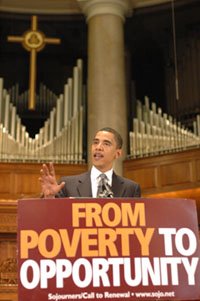
And though my friends and family are sick of me talking about Barack Obama, I’ve not mentioned him here. Now I have to. Obama has just given his most important speech since his inspirational address at the Democratic National Convention in 2004. This message for Call to Renewal’s Pentecost 2006 conference focused on matters of faith and politics.

Since then, he has been criticized from all quarters. Moderate Democrats are nervous that Obama might upset secularist friends. Confirmed secularists are infuriated that Obama would suggest that religious faith has any place in the public square (lots of blather about the difference between religious faith and other types of beliefs. What the secularists ignore is the fact that their faith also informs their decision-making. Those who champion intellect as the great arbiter of truth deceive themselves into believing that they make all decisions without any input other than intellect. The fact is their FAITH in intellect informs this decision-making, which is not the same as intellect itself. And their feelings and history and current life situations all inform their decision-making.) Some folks from the Religious/Political Right seem nervous that a Democrat might actually talk about God in public. Al Mohler calls Obama a secularist with a religious veneer. All quarters seem to wonder if this is all politics—-pandering to an audience. Some suggest that he is faking his interest in this area. Many are convinced that Obama has finally completed his indoctrination by the Washington compromisers.

Most of these folks are missing Obama’s points entirely. I fault mainly the Associated Press reports which summarize the speech as “Obama Courting the Evangelicals” or “Obama Chastises Fellow Democrats.” While evidence for both headlines can be found, read the speech or hear it, and you’ll see that neither headline fairly represents the speech or its points. Associated Baptist Press presents a more objective and accurate summary of the speech.

First of all it should be noted that while the Call to Renewal folks are evangelicals in the truest sense (They call people to be Jesus-followers), they are not evangelical in the sense that most public discourse hears. That is: they are more likely to vote with Democrats than Republicans in most areas. Unfortunately many people, particularly secularists, read “evangelical” to mean “fundamentalist,” and this audience is anything but fundamentalist. So if Obama is courting their vote, it’s probably from folks who would be leaning his way anyway.

I read and heard Obama’s speech more like a politician’s honest reflections about reconciling his vocational mission with his personal beliefs. And he reflects out loud about where those deliberations have taken him.

It reminds me of the confusion people seem to have about Abraham Lincoln. I respect Lincoln, without believing the myth and legend about him. He was a mere man . I don’t respect him for freeing the slaves (he didn’t directly) No, what impresses me about Lincoln is that while presiding over still the darkest time in our nation’s history, Lincoln had to wrestle with personal faith /feelings (anti-slavery) with a vocational objective (to preserve the union). His antislavery views had been highly publicized, but he had a job to do which he felt sworn to. Thus you get the eloquent, anguished, God –soaked, 2nd Inaugural Address.

“All knew that this interest [slavery] was somehow the cause of the war. To strengthen, perpetuate, and extend this interest was the object for which the insurgents would rend the Union even by war, while the Government claimed no right to do more than to restrict the territorial enlargement of it. Neither party expected for the war the magnitude or the duration which it has already attained. Neither anticipated that the cause of the conflict might cease with or even before the conflict itself should cease. Each looked for an easier triumph, and a result less fundamental and astounding.

Both read the same Bible and pray to the same God, and each invokes His aid against the other. It may seem strange that any men should dare to ask a just God's assistance in wringing their bread from the sweat of other men's faces, but let us judge not, that we be not judged. The prayers of both could not be answered. That of neither has been answered fully. The Almighty has His own purposes. "Woe unto the world because of offenses; for it must needs be that offenses come, but woe to that man by whom the offense cometh." If we shall suppose that American slavery is one of those offenses which, in the providence of God, must needs come, but which, having continued through His appointed time, He now wills to remove, and that He gives to both North and South this terrible war as the woe due to those by whom the offense came, shall we discern therein any departure from those divine attributes which the believers in a living God always ascribe to Him? Fondly do we hope, fervently do we pray, that this mighty scourge of war may speedily pass away. Yet, if God wills that it continue until all the wealth piled by the bondsman's two hundred and fifty years of unrequited toil shall be sunk, and until every drop of blood drawn with the lash shall be paid by another drawn with the sword, as was said three thousand years ago, so still it must be said "the judgments of the Lord are true and righteous altogether."


Obama mentions the God-ness of the address in his speech. Not that Obama’s speech approaches the profundity of Lincoln’s, or that his anguish at this time approaches the anguish of President Lincoln, but the speech is born of a similar internal and occupational struggle. He affirms his own Christian faith, but talks about political openness to people of all beliefs including secularists. He calls on fellow liberals and Democrats to embrace their faith and openly bring it into the square. So some liberal commentators see these words as Obama feeding the cause of Republicans, reinforcing their stereotypes.

But it is not that he believes with some Republicans that Democrats are Godless. Quite to the contrary. He is calling those God-believing Democrats (that is: MOST Democrats) to vocally admit their faith. To do otherwise is not only deceptive, it creates the vacuum that only fundamentalists can fill. In Obama’s actual words, he says that conservative leaders tell

"evangelical Christians that Democrats disrespect their values and dislike their Church, while suggesting to the rest of the country that religious Americans care only about issues like abortion and gay marriage; school prayer and intelligent design.

"Democrats, for the most part, have taken the bait. At best, we may try to avoid the conversation about religious values altogether, fearful of offending anyone and claiming that - regardless of our personal beliefs - constitutional principles tie our hands. At worst, some liberals dismiss religion in the public square as inherently irrational or intolerant, insisting on a caricature of religious Americans that paints them as fanatical, or thinking that the very word "Christian" describes one's political opponents, not people of faith.
”

And he is right. If Democrats/liberals want to change, they must first admit that they have a problem. By “they” I mean anyone who decides that they can’t mention God in public because it might offend their constituency.

Barack Obama is calling these folks to embrace their faith, to not let the Religious/Political Right dictate what is Christian or what is appropriate talk of God in politics. Obama’s speech was not designed so much to court evangelicals as it was to call Democrats and other liberals to acknowledge the role their faith plays and to not apologize for that faith. And he wants to serve notice to the Religious/Political Right that they do not own God. Thank God for Barack Obama who is willing to infuriate secularists, and all Republicans and Democrats alike. If he’s courting votes, he’s got a funny way of doing it.